
Year 3 (2025-26) Subprojects
Paper-based antibiotic susceptibility test for urinary tract infections
PI: Emily Melzer
Latde Diagnostics
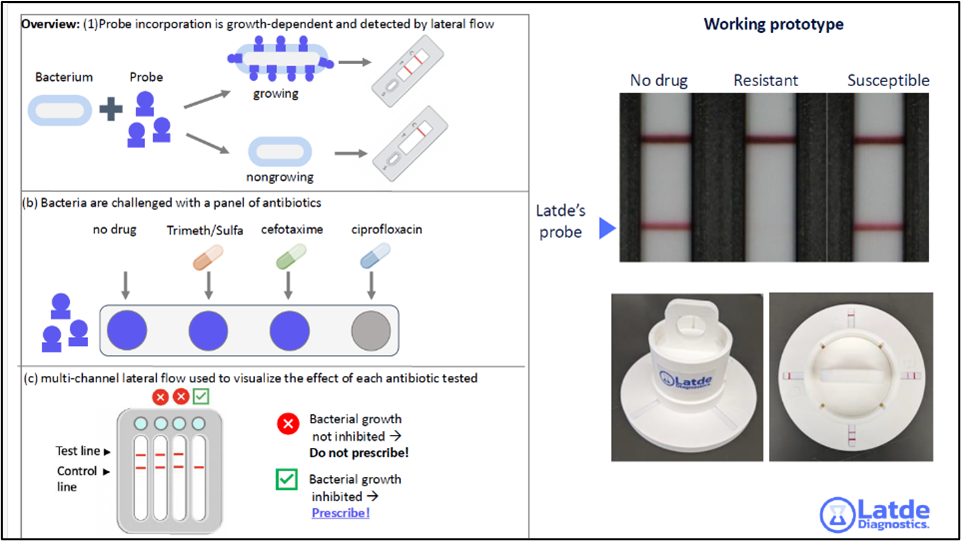
We are developing a rapid, accessible antibiotic susceptibility test (AST). Our test detects actively-growing bacteria using metabolic labeling of the bacterial cell surface. We showed that the test can differentiate between resistant and susceptible bacteria isolated from UTIs and is agnostic to bacterial species and antibiotic. While the test output can take multiple forms, in an effort to design an AST that is easily-deployed, financially-accessible, commercially-viable and societally-impactful, we paired our labeling approach with a Lateral Flow Assay (LFA) readout. This ensures that testing requires no specialized equipment and can be performed in clinical settings that lack the resources required for other rapid ASTs. Our first product, an AST kit for UTIs, will comprise a multi-well strip where bacteria are challenged with a customizable antibiotic panel. Bacteria then feeds into an LFA cassette that indicates bacterial response to antibiotics, thereby guiding judicious, effective prescription.
Fully Sustainable, Self-Contained Heating and Reporting Solution to Replace Batteries in Point-of-Care Diagnostics
PI: Michael Mina
RT MicroDx
Current POC molecular diagnostics require batteries, hubs and external power, driving costs, complexity, and environmental impact. For many POC solutions, simple, hub-free, single-use tests are demanded. But single-use is often wasteful. We are developing an extremely eco-friendly, single use, accessible, molecular testing platform for home-based and POC platform, beginning with Strep A.
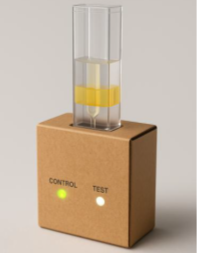
Our solution is a fully disposable, ultra-low-cost, extremely eco-friendly LAMP molecular platform, initial indication for Group A Strep with saliva. It is powered by a highly sustainable paper-cell battery, incorporates iron-oxide and printed carbon-ink layers for heating and impedance detection with a micro-LED readout. The system is housed in a corrugated cardboard shell, dramatically reducing cost, complexity, and environmental burden. Unlike current POC molecular systems – reliant on expensive instruments, lithium batteries, or hubs – our platform is self-contained, instrument-free, and designed for true environmental sustainability. Paper-cell batteries are safe, biodegradable and low-cost, but limited in power. We integrate an oxygen-activated iron-oxide heater to ~55 °C, making the paper-cell battery responsible only for the 10°C delta to reach 62–65 °C. This novel hybrid heating system, paired with microelectronics, printed heating/detection layers, and no moving parts, enables high-performance molecular diagnostics in a compact, affordable, and truly sustainable format.
Advancing Pre-eclampsia Diagnosis: A Novel Point-of-Care Biomarker Assessment Tool
PI: Julia Finkelstein
Cornell University
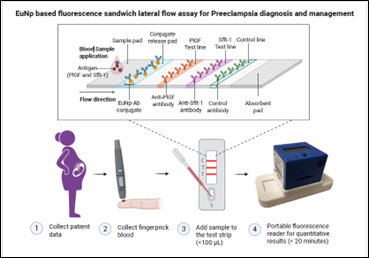
The currently available diagnostics for Preeclampsia (PE) are expensive, time-consuming, require lab settings and trained personnel; we propose a portable, low-cost and rapid point-of-care test for PE biomarkers PlGF and sFlt-1, that enables early, field-based PE screening using minimal blood volume and no specialized training or equipment.
We propose a novel, low-cost and portable point-of-care (PoC) diagnostic platform for PE screening that targets PlGF and Sflt-1. While current clinical practices and diagnostic assays rely on large blood volumes, high-cost diagnostics and centralized labs, our diagnostic platform will deliver rapid, quantitative results from <100 µL of blood in under 15 minutes at the PoC. Adapted from our validated and highly successful AnemiaPhone platform, this lateral flow assay system is fully digitized, scalable, and designed for field and bedside use in low-resource and community settings. Its ability to multiplex assays rapidly and reliably will offer a transformative solution for early detection and management of PE. Our proposed platform combines the simplicity of lateral flow tests with the analytical rigor of lab-based assays, bridging critical diagnostic gaps in public health and enabling widespread, decentralized screening to alleviate the PE burden in the US.
Rapid tuberculosis diagnosis from respiratory or blood samples by a low cost, portable lab-in-tube assay
PI: Weijun Zhang
IGDX Inc (DBA Intelligenome Inc)
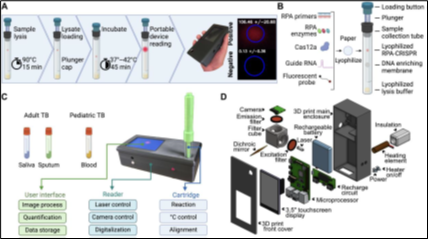
A low complexity, lab-in-tube system read by an integrated handheld device that detects Mycobacterium tuberculosis (Mtb) DNA in blood and respiratory samples from a variety of clinical settings. This microprocessor-controlled device uses an LCD user interface to control assay performance, automate assay analysis, provide results in a simple readout.
This platform is an inexpensive, handheld, battery-powered lab-in-tube (LIT) TB assay that detects Mycobacterium tuberculosis (Mtb) DNA in serum, saliva, and sputum. A sample-to-answer in less than 1 hour is our solution for a POC test for multiple TB manifestations. This assay integrates sputum or saliva specimen liquification, Mtb bacilli lysis, recombinase polymerase amplification (RPA), and CRISPR detection steps into one tube which is processed and analyzed by the portable assay device. In EPTB patients or children, the assay uses serum facilitating TB detection with increased sensitivity. The consumables include assay tubes with lyophilized solubilization material, and a separate matrix embedded with lyophilized RPA and CRISPR reagents. This allows sequential specimen solubilization and RPA-CRISPR detection, using two protospacer-associated motif (PAM) free guide RNAs (gRNAs) for optimized target detection. Our POC device can detect adult and pediatric TB (PTB and EPTB) with high sensitivity and specificity in serum, saliva, or sputum. settings.
StrepAI: Expanding Point-of-Care Strep Throat Screening for Global Deployment Readiness
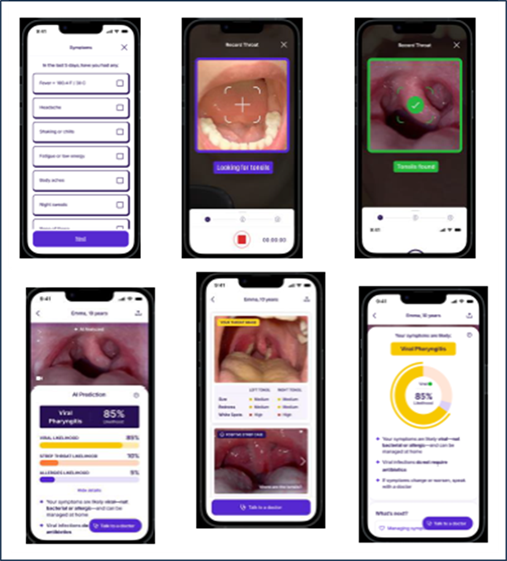
PI: Therese Canares, Curie Dx
Limited access to test for acute febrile illnesses (e.g., strep throat) in low/middle-income countries leads to antibiotic misuse and sequelae (rheumatic fever). StrepAI is a mobile app that predicts strep throat with a picture & computer vision at 89%AUC. This project proposes linguistic/cultural adaptation, on Android, to improve global accessibility.
Globally, strep throat (Group A Streptococcal pharyngitis) affects over 500 million individuals annually and remains a major contributor to inappropriate antibiotic use in low- and middle-income countries (LMICs), where diagnostic tests are scarce. StrepAI is a smartphone-based, AI-powered screening tool that analyzes oropharyngeal images and provides decision support for Group A Streptococcal (GAS) pharyngitis. Curie Dx has developed and validated an iOS prototype with high diagnostic performance. This year, we are expanding access by building an Android version and adapting the platform linguistically and culturally to better serve under-resourced regions.
General Personalized Metabolic Monitoring & Coaching Platform Using Glucose Biosensors and AI to Prevent and Reverse Prediabetes

PI: Dan Zovorotny
Nutrisense
Continuous glucose monitors, Nutrisense analytics, and insurance‑covered nutrition coaching combine to give real‑time, individualized insight that empowers behavior change, improves metabolic health, and prevents progression from prediabetes to diabetes.
We will integrate FDA cleared glucose biosensors and fitness trackers with proprietary mobile software that ingests raw interstitial glucose every 15 minutes, applies adaptive algorithms to flag glycemic variability, and overlays user logged meals, exercise, and sleep. AI models generate personalized dietary swaps, timing adjustments, or activity prompts grounded in the user’s own data. Users schedule one on one video visits with registered dietitians directly in app. Visits are billable to insurance under existing CPT codes. Unlike isolated glucose biosensors or generic diet apps, this solution offers a closed loop of biosensor, analytics, and credentialed coaching, making real time metabolic guidance practical at home, in workplaces, or in community clinics. This project aims to evaluate the real-world performance and usability of combining glucose biosensors with analytics and human coaching as a practical point of- care solution for early detection and support of prediabetes management.